Pediatric Sensory Disorder in Lake Charles
You have been told he is difficult, or that you are too soft on him. You know the difference between a tantrum and a child whose whole system has gone into alarm.
What causes sensory processing difficulty?
Every child is taking in several streams of information at once: sound, light, touch, taste, smell, movement, and where the body is in space. The nervous system has to decide what matters and what to ignore. Sensory processing difficulty is a problem with that filter, not with behavior or discipline. When the filter runs too hot, an ordinary room becomes threatening. When it runs too cold, a child has to create huge amounts of input just to feel organized. Both look like misbehavior from the outside, and neither one responds to consequences.
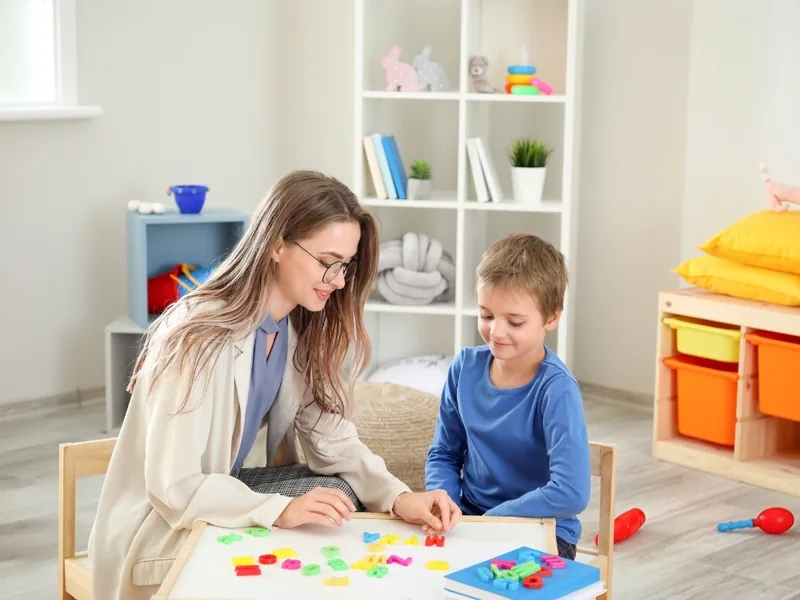
Some children take in ordinary input as far too much. A tag in a shirt, a hand dryer, fluorescent lights, a hug from the wrong person, and the nervous system reacts as though to a threat. That response is fast, physical and not chosen, which is why reasoning with a child in the middle of it does not work. Therapy lowers the baseline first and builds tolerance second, in that order.
Other children get a faint signal and go looking for more. They crash into furniture, chew their clothing, run when they should walk, squeeze too hard and never seem to stop moving. This is not defiance, it is a nervous system trying to reach the level where it feels organized. Given the right input at the right points in the day, these children settle in a way no amount of asking achieves.
The inner ear and the sensors in muscles and joints tell a child where their body is without looking. When that information is unreliable, they may be frightened to have their feet off the ground, hate having their head tipped back at the sink, or need to keep moving to know where they are. Swings, climbing, heavy work and controlled movement are the tools here, and the dose matters as much as the activity.
A very limited food range is often sensory before it is behavioral. Texture, temperature and smell can make a food genuinely intolerable rather than merely disliked, and a child cannot be argued out of that. Our occupational therapists and feeding therapists work this together, widening the range in small graded steps, and we do not use pressure at the table because pressure reliably narrows the diet further.
Most of the hard moments happen at the seams of the day: waking, leaving, arriving, stopping something enjoyable, going to bed. A child already running near the top of their tolerance has nothing left for a change of plan. Work on regulation gives your child, and you, a set of strategies that bring the system down before it tips, plus routines and warnings that make transitions predictable.
Sensory differences frequently accompany autism, attention difficulties, prematurity and language delay, and they can also stand entirely on their own. We do not diagnose those conditions here, and we do not need a label to begin work on regulation and tolerance. What we will do is tell you honestly what we are seeing, and point you to the right provider when a fuller evaluation would help.

How therapy in Lake Charles helps.
We start with your day, not a checklist. The evaluation combines a structured sensory history with watching your child in the clinic: what they seek out, what they flee, how quickly they escalate, and what brings them back down. From that we build a sensory plan, meaning specific activities and specific adjustments placed at the points in the day where your child is most likely to come apart. Sessions are one on one with an occupational therapist and run 30 to 60 minutes.
The room matters too. Our Lake Charles clinic is a calm, quiet space rather than a bright open gym, something one parent singled out in a Google review, and for a child already at their limit that difference is often the reason a session works at all. From there we widen tolerance in small graded steps, never by flooding, and we teach you the strategies so they hold up at home, at the store and at school. Most families come two to three times a week for four to six weeks and see regulation improve before tolerance does. Our front office verifies your benefits, deductible and visit limits before the first appointment, tells you what you will owe up front, and confirms exactly what your plan requires by way of a physician referral for occupational or speech therapy.
What to expect from your child's care.
History, observation and a real baseline
The first visit maps which senses are over-responsive, which are under-responsive, and where in the day the trouble concentrates. You talk, we watch, and we put clinical language to a pattern you have been describing to people who had no name for it.
A sensory plan built into the day
We choose specific input and specific timing: before school, after school, before bed, before the store. Sessions build tolerance in graded steps with your child keeping some control of the pace, and we teach you the strategies so they work outside this building.
Carryover, school and the long view
The plan is only useful where your child actually lives. We help you translate it for teachers and caregivers, adjust it as your child grows and the demands change, and reassess regularly so you can see whether it is working.
Started coming to get my Son Occupational Therapy, and he Loves his therapist she is super sweet and it has a wonderful atmosphere here very relaxing and calm, no loud noises.
Often part of a bigger picture.

Swallowing & Feeding Therapy
Help for a very limited food range, difficulty swallowing and mealtimes that have stopped working.
Learn More →
Pediatric Dysgraphia
Building the hand strength, motor planning and endurance behind legible, comfortable handwriting.
Learn More →
Pediatric Balance Disorder
For the child who trips, freezes on the stairs and has stopped trying the playground.
Learn More →