Speech and Sound Disorders in Lake Charles
You have been told he will grow out of it. Eighteen months on, you are still translating for him. An evaluation tells you what is actually happening and what to do about it.
What causes speech and sound disorders?
Every child drops sounds while they are learning to talk. The question is not whether errors happen, it is whether they are clearing on schedule. When a four year old still cannot be understood by a teacher, or a first grader is being corrected all day, the pattern behind it matters more than the sound itself. Our Speech and Sound Disorders Program starts with figuring out which pattern you are dealing with, because articulation, phonology and apraxia look similar from the kitchen table and are treated in completely different ways.
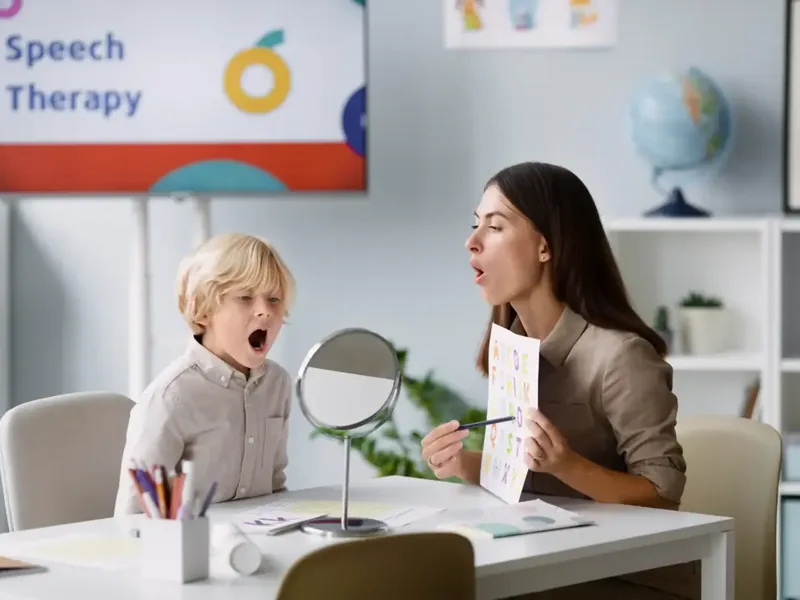
Sometimes the difficulty is purely motor: the tongue, lips or jaw are not getting into the right place for a specific sound. A lisped s, a w for r, a th for s. These are individual sounds rather than whole systems, and they respond well to direct practice once a therapist shows the child exactly where the tongue goes and gives them enough correct repetitions to make it automatic.
Other children can make the sounds in isolation but apply a rule that simplifies whole categories of words. They may drop every final consonant, swap every back sound for a front one, or reduce every cluster. Because the errors follow a rule, targeting one sound at a time is slow. Targeting the pattern collapses several errors at once, which is why an accurate assessment saves months of therapy.
In apraxia, the muscles are capable but the brain struggles to plan and sequence the movements for speech. The same word comes out differently every attempt, longer words fall apart, and progress with ordinary drilling stalls. Apraxia needs a different approach built on heavy repetition, movement cues and carefully chosen target words. Taylor Dunn has completed continuing education specifically in moving nonverbal children toward verbal communication in autism and apraxia.
A restricted tongue tie, an open-mouth resting posture or a tongue that pushes forward on every swallow changes how sounds are formed. Speech drills alone rarely fix a structural driver. Sonya Brooks is a Certified Orofacial Myologist, so when the exam points to oral structure or muscle function we address that alongside the sound work instead of treating them as separate problems.
Children learn sounds by hearing them clearly and repeatedly. Repeated ear infections, fluid behind the eardrum or a period of untreated hearing loss during the toddler years can leave gaps in that input. Speech therapy fills the gaps once hearing is stable, and part of our evaluation is checking whether a hearing review should come first.
Sometimes unclear speech is the visible edge of a broader language delay: a small vocabulary, short sentences, difficulty following directions. Treating only the sounds leaves the harder problem in place. We screen expressive and receptive language at the evaluation so the plan targets whichever layer is actually holding your child back.
Children who are not understood stop trying. They shorten answers, let a sibling speak for them, or go quiet with adults outside the family. Every avoided conversation is lost practice, so the gap widens even when nothing else has changed. Rebuilding willingness to talk is part of the therapy, not a side effect of it.
How speech therapy in Lake Charles helps.
A licensed speech-language pathologist starts with a full speech sound inventory: which sounds your child has, which they are missing, which errors follow a rule, and how intelligible they are to a stranger rather than to you. We look at oral structure and function, screen language and hearing history, and listen to connected speech, not just single words. That is what separates an articulation plan from a phonological plan from an apraxia plan, and getting it right is the difference between steady progress and a year of drilling that never generalizes.
Sessions are one-on-one and built around play, because a child who is engaged produces far more repetitions than a child being tested. Targets are chosen for impact: the sounds and patterns that will make the most words understandable soonest. You get the same cues to use at home, which is where most of the practice actually happens. Sessions run 30 to 60 minutes, most children attend two to three times a week for four to six weeks before the first formal reassessment, and many parents hear a change within the first few weeks. Our front office verifies your specific benefits, deductible and visit limits before the first appointment, so you know what you will owe before you walk in.
What to expect from the program.
Evaluation and a named diagnosis
We build a complete sound inventory, check oral structure and function, screen language and review hearing history. You leave the first visit knowing which pattern your child has, in plain words, and what the targets will be. No waiting weeks for a report you cannot read.
High-repetition therapy with home carryover
We drill the chosen targets through play, from single sounds to syllables to words to phrases, at whatever level your child can succeed. You watch the cues we use and take them home, because ten minutes a day between sessions moves faster than the session alone.
Generalization, then discharge
A sound is not learned until it shows up in conversation with people who do not know your child. We measure intelligibility in connected speech, add harder contexts, then discharge with a plan. Your therapist reassesses regularly, so you always know whether it is working.
We came for speech therapy for my toddler, and the difference in his abilities before and after is incredible. Taylor really did a fantastic job and was such a joy to work with.
Speech rarely travels alone.

Orofacial Myofunctional Disorders
Tongue ties, mouth breathing and tongue thrust addressed by a certified orofacial myologist.
Learn More →
Swallowing & Feeding Therapy
Safer swallowing and calmer mealtimes for infants, children and adults.
Learn More →
Dyslexia
Structured literacy support for children whose reading does not match their intelligence.
Learn More →