TMJ and TMD in Lake Charles
You were given a night guard and told to eat soft foods. A guard protects your teeth from the clenching. It does not tell you why you are clenching.
What causes TMJ and TMD?
The temporomandibular joint is the most used joint in your body. You load it every time you talk, chew, yawn or swallow, which happens well over a thousand times a day. TMD is the umbrella term for when that system stops working comfortably, and it covers several different problems that produce similar symptoms. Some are joint problems, some are muscle problems, and some are habit and posture problems that keep reloading the joint. Sorting out which one you have is the difference between managing jaw pain forever and resolving it.

Most people clench without knowing it, often at night or during focused work. The jaw muscles are strong and built for short bursts, not sustained contraction, so hours of low-grade clenching leaves them tender, shortened and quick to fatigue. A night guard protects the teeth from that force. It does not reduce the force, which is why the ache in the temples and the sore jaw in the morning often continue.
A small cartilage disc sits between the jaw and the skull and glides with every opening. When it slips out of position you get the classic click or pop, and if it fails to reduce the jaw can catch or lock. Not every click needs treatment, but a click with pain or restriction does, and the plan targets the muscles and mechanics controlling how the joint tracks.
The masseter, temporalis and pterygoid muscles refer pain in patterns that rarely feel like the jaw. Patients describe temple headaches, ear fullness, pain behind the eye or aching teeth. Because the pain shows up away from its source, people are often assessed for the wrong thing first. Releasing those muscles frequently changes symptoms that had gone unexplained for months.
The jaw hangs from the skull and the skull sits on the neck, so where your head sits changes how your jaw rests and closes. A forward head position over a desk or phone shifts the resting jaw and increases muscle work all day. Treating the jaw without treating the neck is why so much TMD care gives short-lived relief.
Where the tongue rests, whether you breathe through your nose, and how you swallow all shape jaw mechanics thousands of times a day. A low resting tongue, chronic mouth breathing or a tongue-thrust swallow keep the jaw muscles working when they should be idle. Sonya Brooks is a Certified Orofacial Myologist, so when the exam points here we retrain the pattern rather than only treating the sore muscle.
A blow to the jaw, a whiplash injury, or several hours held open during a dental or surgical procedure can irritate the joint and its surrounding muscles. Symptoms sometimes appear days later, which makes the connection easy to miss. Restoring normal range and control early prevents the guarding pattern that follows an irritated jaw.
The jaw is where a great many people hold tension, and poor sleep both raises clenching and lowers pain tolerance. This is not a suggestion that the pain is imagined. It is a real mechanical loop: stress increases muscle activity, muscle activity produces pain, pain disrupts sleep, and the cycle repeats. Breaking any link in that loop makes the others easier to change.

How physical therapy in Lake Charles helps.
The evaluation measures rather than guesses. We record how far you open, whether the jaw deviates on the way, where it clicks in the range, which muscles are tender and what they refer to, and how your neck and head position behave while all of that happens. We also look at resting tongue position, breathing and swallowing, because those load the jaw far more often than chewing does. That combination is what tells us whether you are dealing with a joint, a muscle, a habit or, most commonly, a mix of all three.
Treatment then follows the four phases we use across the clinic: Pain, Prime, Perform, Prevent. Pain work uses hands-on treatment of the jaw and neck muscles, and dry needling where it is appropriate, to bring the tenderness down. Prime restores clean, symmetrical opening and closing so the joint stops catching. Perform builds endurance in the muscles that control the jaw and the deep neck, because relief only holds if the system can handle a full day. Prevent addresses the habits: resting posture, tongue position, nose breathing, and what to do at the desk. Sessions run 30 to 60 minutes, most people attend two to three times a week for four to six weeks, and many notice a change within the first few weeks. Louisiana is a direct access state, so you can start without a physician referral, and our front office verifies your benefits and visit limits before your first appointment.
What to expect from your recovery.
A measured jaw and neck exam
We measure opening in millimeters, track deviation through the range, map which muscles are tender and where they refer, and assess the neck, resting tongue position and breathing. You leave the first visit knowing whether your problem is joint, muscle, habit or a combination, and what the plan targets first.
Settle the muscles, restore the glide
Early sessions bring pain down with hands-on work to the jaw and neck and dry needling where appropriate, then rebuild smooth, symmetrical opening. You get a short daily routine, because a jaw you use a thousand times a day responds to small frequent input more than to one weekly session.
Change the habit, keep the result
The lasting piece is what your jaw does when you are not thinking about it. We retrain resting position, nose breathing and swallowing, and adjust desk and phone posture. We reassess regularly so you know whether it is working, and if there is no documented improvement within 30 days we refer you back to a physician.
Jaw pain rarely travels alone.

Orofacial Myofunctional Disorders
Tongue ties, mouth breathing and tongue thrust addressed by a certified orofacial myologist.
Learn More →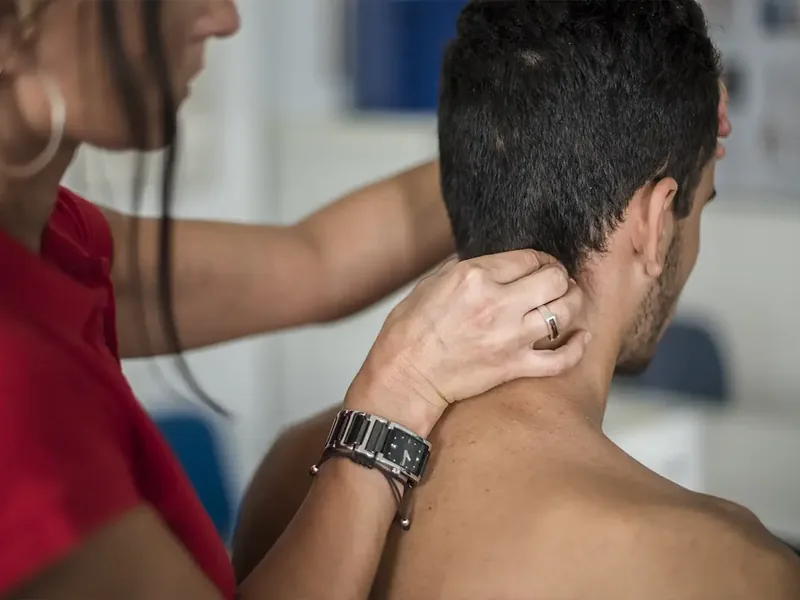
Neck Pain
Relief for stiff, aching necks by treating the joints, muscles and posture driving the pain.
Learn More →
Swallowing & Feeding Therapy
Safer swallowing and calmer mealtimes for infants, children and adults.
Learn More →