Parkinson's Disease Treatment in Lake Charles
You have been told to take it easy and wait for the medication to settle. Taking it easy is why the steps got shorter. Our neurological rehab specialist is LSVT certified, and the work here goes the other direction: bigger, louder, on purpose.
What causes Parkinson's symptoms?
Parkinson's comes from the gradual loss of dopamine-producing cells in the brain, and therapy does not reverse that. What therapy does change is almost everything you actually notice day to day. The disease makes movement and voice get quietly smaller without telling you, and the natural response, doing less, accelerates it. Knowing which symptom is the disease and which is the response is what makes a plan worth following.

This is the most important thing to understand about Parkinson's. The brain loses its ability to judge how big a movement needs to be, so steps get shorter, handwriting shrinks, arms stop swinging and the voice quietens. Crucially, it all feels normal from the inside. You are not choosing to move less; your brain is telling you the smaller version is full size. That mismatch is what amplitude training targets.
Muscle stiffness builds through the trunk and shoulders, and the body starts turning as one block instead of rotating. Rolling over in bed, standing from a chair, checking a blind spot and reaching behind you all depend on rotation. Left alone the chest and hip flexors shorten and posture folds forward, which makes balance worse. Rotation is one of the first things we go after.
Freezing is the sudden sense that the feet are stuck to the floor, and it strikes at doorways, on turns, in tight spaces and when you hurry. It is not weakness or hesitation. It is trainable: cues such as counting, a metronome beat, marks on the floor or a deliberate weight shift give the brain a different route into the step. We practise these where you actually freeze, not in an open hallway.
Parkinson's blunts the automatic reactions that catch you when you trip, so recovery from a stumble comes late. Add a forward posture and short steps and falls become likely rather than unlucky. Balance only changes when it is trained near your real limit, which is why supervised work beats walking laps at home. The aquatic pool at our Lake Charles clinic lets us push it harder than the floor safely allows.
The same shrinking that shortens a step also softens a voice. People ask you to repeat yourself, phone calls get difficult, and you get accused of mumbling when the real issue is volume. Swallowing muscles slow the same way, showing up as coughing on thin liquids, pills getting stuck or meals taking much longer. Both respond to targeted work with a speech-language pathologist, and both are worth addressing early.
This is the part that is not the disease. Movement gets harder, so you do less. Doing less costs strength, endurance and confidence, which makes movement harder still. That spiral can account for more of your limitation than the Parkinson's itself, and it is the most reversible thing on this list. It is why we would rather see you early, while there is more to protect.

How physical therapy and speech therapy in Lake Charles help.
Dr. James Marcantel is our neurological rehab specialist. He works with stroke, spinal cord injury, traumatic brain injury and Parkinson's, and he is LSVT certified. The principle is deliberately counterintuitive: because the brain has recalibrated normal downward, you practise movements that feel exaggerated until an exaggerated step is what normal feels like again. It has to be high effort and high repetition, which is why sessions are one-on-one and genuinely hard work rather than a gentle stretching class.
The voice gets the same treatment on the speech side, with loudness trained directly rather than politely, plus swallowing work when meals or pills have become a problem. Occupational therapy handles what quietly disappears first: buttons, handwriting, getting dressed, managing a kitchen safely. Having all three disciplines in one building matters, because Parkinson's does not respect the boundaries between them. We also train whoever helps you at home, since a cue that stops a freeze in the clinic only helps if someone can use it at 6am.
What to expect from therapy.
First, the practical questions. Louisiana is a direct access state, so no physician referral is needed to start physical therapy, and if there is no documented improvement within 30 days we refer you back to a physician and help arrange it. Our front office verifies your benefits, deductible and visit limits before the first appointment, so you know what you will owe before you walk in. Sessions run 30 to 60 minutes, usually two to three times a week for four to six weeks in a block, and many people notice a change in stride or voice volume within the first few weeks.
Baseline measurement
We measure rather than estimate: walking speed, stride length, how long it takes to stand from a chair, balance under challenge, turning, voice loudness, and a swallowing screen if you need one. We ask where you are in your own timeline and what has changed in the last six months. You leave with real numbers, which is what makes progress arguable later instead of a feeling.
Amplitude and intensity
The main block of work. Big-amplitude movement practised at high effort, strength through the hips and trunk, rotation restored, freezing rehearsed with cueing in the places it actually happens, and voice and swallowing trained on the speech side. It is demanding by design, because intensity is what drives the change, and we scale it to what you can do today.
Carryover and maintenance
Parkinson's is progressive, so the goal is not discharge and forget. You leave with a home program you can sustain, cues your family knows how to use, and a clear picture of what to watch for. Coming back for a shorter block when something slips is normal and expected, not a sign the first one failed.
Kristen is the BEST!!!!! She has helped my mother very very much. Thanks Hope Therapy.
Parkinson's rarely shows up alone.

Stroke Recovery
The other half of our neurological caseload, rebuilt the same way: measured, intensive and one-on-one.
Learn More →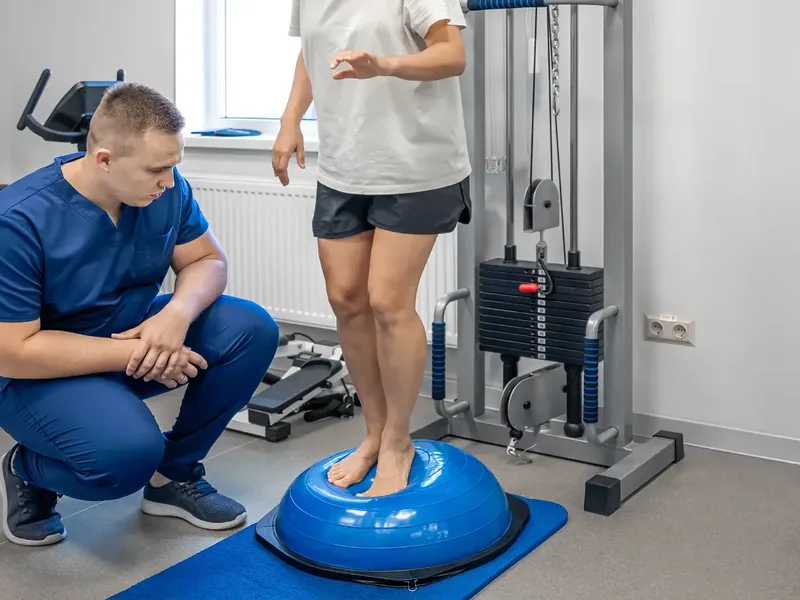
Balance & Gait Disorders
Unsteadiness and shortening steps trained directly, with falls treated as preventable.
Learn More →
Swallowing & Feeding Therapy
Coughing on liquids or pills getting stuck is worth addressing early, not after a problem.
Learn More →