Balance & Gait Disorders in Lake Charles
Losing your balance is frightening. But fear of falling makes it worse. When your balance improves, your confidence returns, and so does your independence.
What causes balance and gait disorders?
Balance and gait are controlled by three systems working together: your inner ear and vestibular system, your legs and strength, and your vision and proprioception. When any one breaks down, your balance falls apart. The good news is that most balance disorders respond well to targeted physical therapy that retrains these systems.
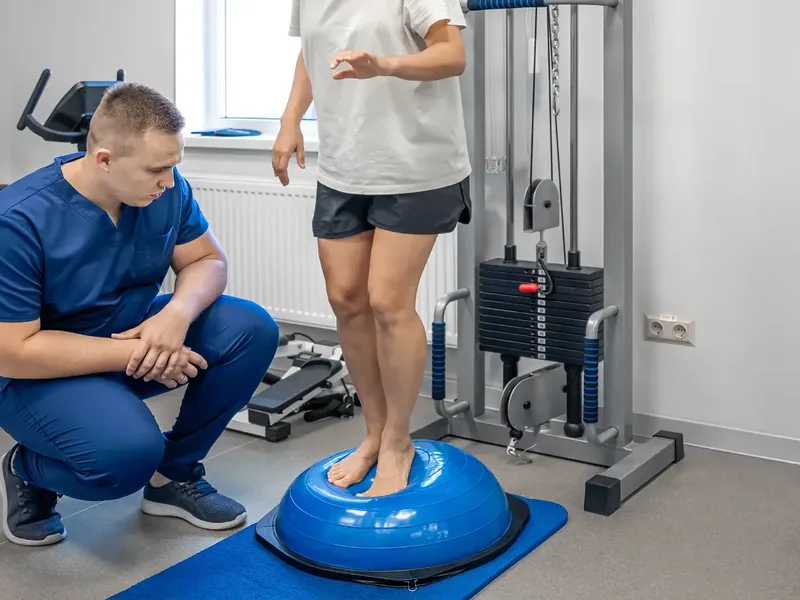
Your inner ear senses head movement and position. When it is inflamed or damaged, your brain gets wrong information about which way is up. This causes dizziness and balance loss. Some cases settle on their own. Others need guided retraining from a therapist who understands the vestibular system.
Your legs and hips are the foundation of balance. Weak quads, glutes, or ankles cannot hold you upright when balance is challenged. Gravity and momentum push you over. Rebuilding strength in the legs is one of the most direct fixes for balance loss.
Your feet and legs tell your brain where you are in space through sensation. When diabetes, age, or nerve damage numbs your feet, that signal breaks. You rely on vision and vestibular input instead, which leaves you unsteady in the dark or on uneven ground. Strengthening and proprioceptive training help compensate.
A stroke or other neurological event can damage the parts of the brain that control balance and walking. Recovery is possible, but it requires retraining. Physical therapy teaches the nervous system new pathways for balance and gait, one step at a time.
One fall creates fear. Fear makes you avoid movement. Avoiding movement makes you weaker. Weaker people fall again. This cycle spirals quickly. Breaking it means rebuilding strength and balance while gradually returning to the activities that make you feel secure.
Some medications list dizziness and balance changes among their side effects. If you cannot change the medication, you can adapt. Physical therapy teaches compensation strategies and rebuilds the parts of your system that can still work.

How physical therapy in Lake Charles helps.
Balance rehab is about retraining your nervous system. We start with an assessment that identifies exactly which system is broken: vestibular, strength, proprioception, or fear. Then we build a plan that retrains that specific system through progressive, challenge-based exercises. Your balance gets better because your brain learns to do its job again. Early sessions are done safely, often with support, so you can push without falling. As you improve, we remove the support and add real-world challenges. You stand on moving surfaces, close your eyes, turn your head while walking, and navigate obstacles. These are the exact scenarios that trip you up in life. By practicing them in therapy, you build the confidence and control to handle them at home. The result is a return to independence and the activities you love.
Because balance draws on several systems at once, your plan may pull in more than one discipline. A licensed physical therapist leads the strength and gait work, and where the inner ear is involved the vestibular side of the plan runs alongside it. If a stroke or a neurological diagnosis is part of the picture, that experience is in the building too. You do not need a physician referral to begin. Louisiana is a direct access state, and if there is no documented improvement within 30 days we are required to refer you back to a physician and will help arrange it. Our front office verifies your benefits, deductible and visit limits before your first visit, sessions run 30 to 60 minutes, and most people attend two to three times a week for four to six weeks.
What to expect from your recovery.
Assessment and safe starting point
We test your balance, gait, strength, and vestibular function. We find what works and what does not. Then we build exercises starting at a level where you can succeed without fear.
Progressive strengthening and retraining
We rebuild the muscles and neural pathways that control balance. Each week the exercises get harder, more complex, and closer to real-world situations. You practice the exact movements that challenge you.
Return to confidence and independence
As balance improves, fear fades. You return to walking without holding on, navigating uneven ground, and living without worrying about falling. Independence is the measure of success.
Unsteadiness rarely stands alone.

Dizziness & Vertigo
When the room spins or your head never quite settles, vestibular testing finds the cause.
Learn More →
Stroke Recovery
Relearning walking, strength and coordination after a stroke, one step at a time.
Learn More →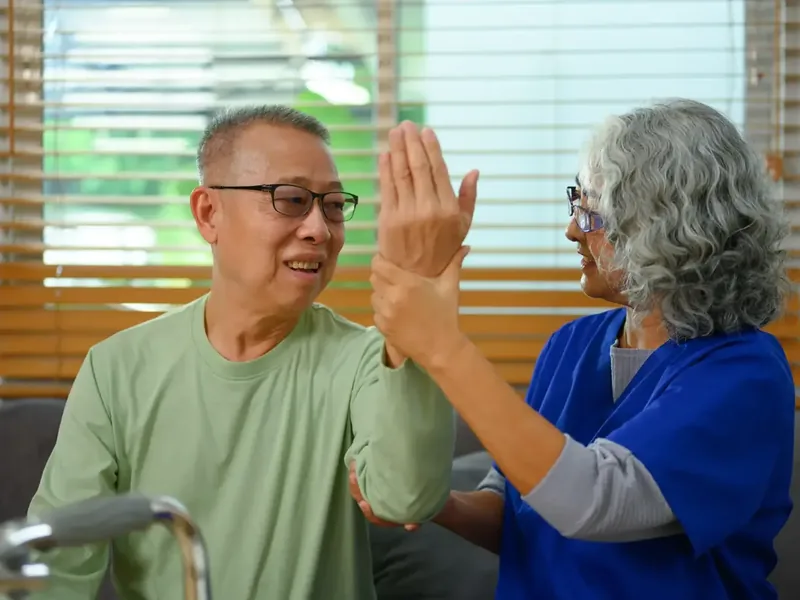
Parkinson's Disease
Bigger steps, better posture and steadier turns through movement work built for Parkinson's.
Learn More →