Vestibular Therapy in Lake Charles
The room moves when you roll over in bed. You have been handed a pill and told it is probably your ears. Vestibular therapy finds which part of your balance system is misreporting, then retrains it.

What is vestibular therapy?
Vestibular therapy is a targeted retraining program for the balance system: your inner ear, your eyes, and the sensors in your joints that report where your body is in space. When those three inputs disagree, the brain does not calmly split the difference. It produces spinning, swimming, fog, nausea, or the specific dread of a floor that no longer feels reliable. The treatment is not rest and it is not medication. Medication can blunt the sensation, but it also slows the adaptation that actually resolves the problem, which is why it tends to keep people dizzy longer. What resolves dizziness is controlled, graded exposure: precise head and eye movements, deliberate position changes, gaze stabilization drills and balance tasks that ask the system to recalibrate instead of avoid. Some cases are mechanical. Loose crystals in an inner ear canal cause short, violent spins tied to specific positions, and a repositioning maneuver performed correctly can settle that in very few visits. Other cases are an adaptation problem after an inner ear illness, a concussion or a long stretch of doing less, and those improve over weeks of consistent work. Telling the two apart is what the evaluation is for.
Dizziness is also rarely a standalone complaint by the time somebody finally books. It arrives with a canceled trip, a fear of driving, a hand permanently on the wall and a couple of near misses on the stairs. So the plan treats the balance system and the habits it created. If you have stopped turning your head while you walk, stopped reaching up to a high shelf, stopped going out after dark, those avoidances get rebuilt on purpose, one at a time, until the world stops feeling conditional.
Who it's for.
If dizziness or unsteadiness has changed what you are willing to do, it is worth an evaluation, whatever you have been told so far. Three patterns account for most of this caseload.
Vertigo triggered by position
Rolling over in bed, lying back at the dentist, or looking up into a cabinet sets off a short, hard spin. The result: testing identifies which canal is involved, and repositioning treatment with proper follow-up often settles this pattern in a small number of visits.
Dizzy since an illness or head injury
Ever since the infection, the concussion or the hospital stay your head has felt swimmy, screens and grocery aisles are too much, and reading makes it worse. The result: graded gaze and habituation work teaches the system to tolerate motion again, so busy places stop ending your day.
Unsteady, and avoiding things
No spinning, just a constant sense that your balance cannot be trusted, so you hold the wall, skip the stairs and stay in after dark. The result: balance and gait retraining rebuilds genuine stability, and the avoidance comes apart along with it.
What to expect in a session.
Bring a driver to the first appointment if your symptoms are provoked easily. A session runs 30 to 60 minutes, and most vestibular plans run two to three visits a week for four to six weeks.
History and positional testing
The single most useful tool is a careful history: what you were doing when it starts, how long it lasts, what makes it stop. From there a licensed physical therapist tests your eye movement, gaze stability, tolerance for head motion, response to position changes, and your balance with and without vision. Some of those tests will briefly provoke your symptoms. That is how we locate the source, and we tell you before we start.
Treatment matched to the finding
If the testing points to loose crystals in a canal, you are treated with a repositioning maneuver and given clear instructions for the hours afterward. If it points to an adaptation problem, you begin gaze stabilization and habituation exercises at a dose you can tolerate, plus balance and walking tasks that remove the crutches you have been leaning on: the wall, the extra step, the fixed stare at the floor.
Progression and home work
Vestibular adaptation is built on frequency, so the home program is not optional and it is deliberately short: a few minutes, several times a day. Each visit your therapist rechecks the provoking tests, moves the difficulty up, and adds back the real-world tasks you have been avoiding. When the tests stop provoking anything and you are doing those things again, you are finished.
Expect a mild, brief increase in symptoms during and after habituation exercises. That is the system adapting, and it should settle within about half an hour. What is not normal is dizziness that arrives with new weakness, slurred speech, double vision, hearing loss or a sudden severe headache. That needs a physician the same day, not an exercise program. Louisiana is a direct access state, so no referral is needed to begin, and our front office verifies your benefits, deductible and visit limits before your first appointment.
Where to go next.

Dizziness & Vertigo
The condition page behind this service: what causes the spinning, and how we test for it.
Learn More →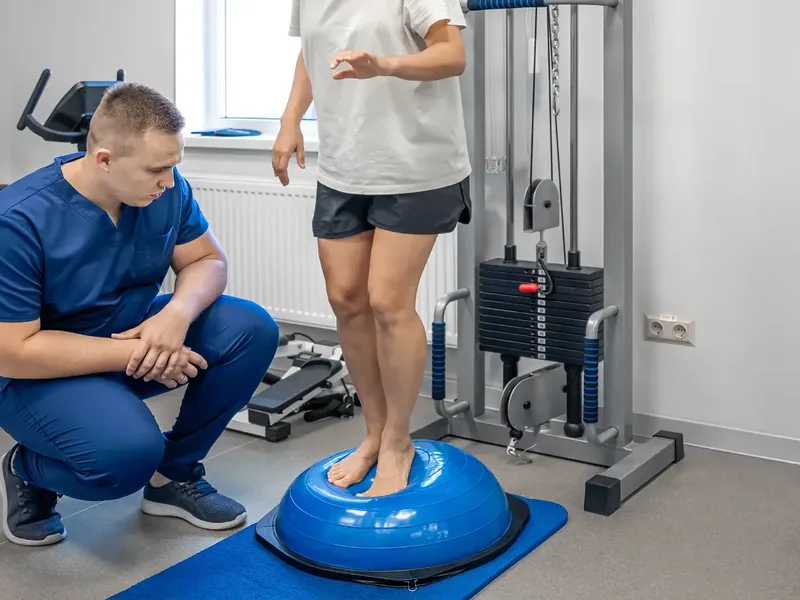
Balance & Gait Disorders
When the problem is unsteadiness rather than spinning, and walking has quietly changed.
Learn More →
Neurological Rehab
For dizziness and imbalance that follow a stroke, a brain injury or Parkinson's disease.
Learn More →